Vicinity
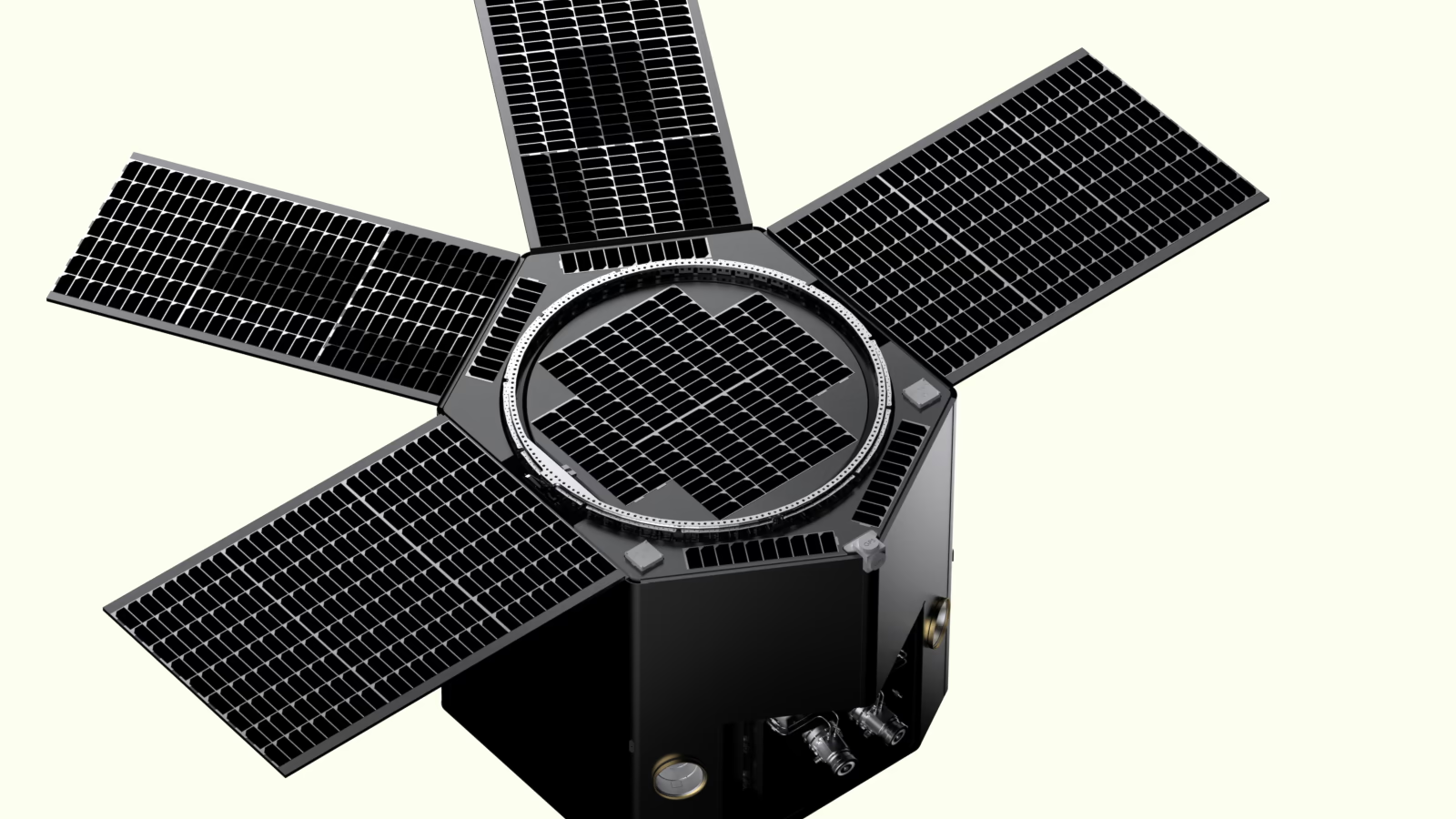
Today we're announcing Vicinity, our second VLEO mission and the newest addition to Albedo's bus product line.
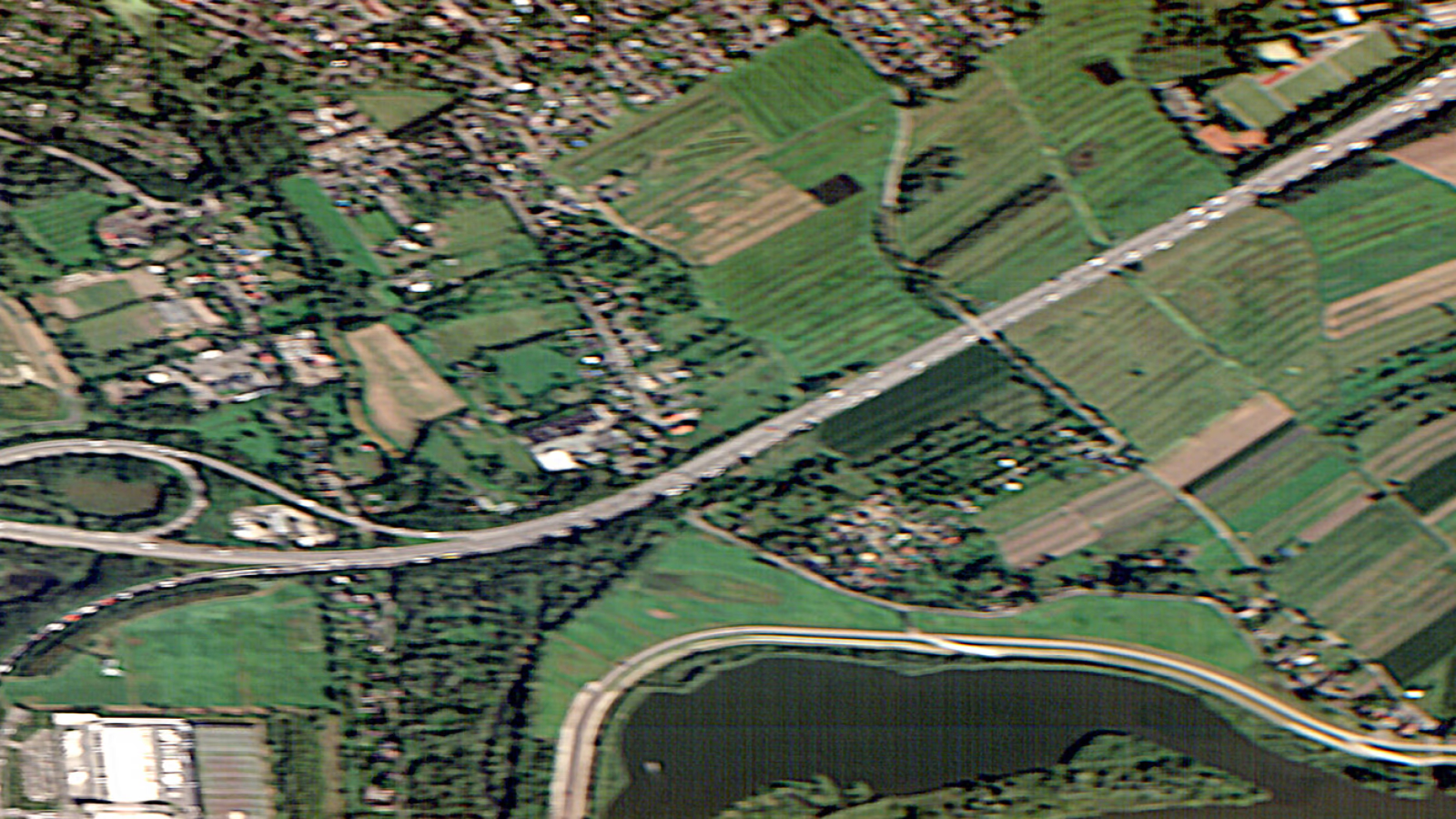
Albedo builds satellites for Very Low Earth Orbit (VLEO). Our first demo mission with the Precision bus and Clarity satellite proved the fundamentals: sustainable orbit operations, drag and lifetime models validated to a five-year lifespan, atomic oxygen resilience, and a flight-proven high-performance platform. Imaging was our first demonstration. It won't be our last.
Vicinity is a VLEO bus purpose-built for higher-power payloads. It inherits the core of our flight-proven Precision bus — the same design philosophy, the same autonomy stack, the same atomic oxygen-resilient solar array technology — but with upgrades and configuration changes that unlock substantially more power.
A few specifics:
- Deployable solar arrays — unlock power-hungry payloads that body-mounted configurations can't serve, while maintaining a ballistic coefficient required to survive in VLEO
- Precision bus core + upgrades — built on the same bus lineage demonstrated on Clarity-1, with our upgraded Gen-2 flight software and a full suite of in-house electronics aboard
- VLEO-native design — engineered from scratch for the drag, atomic oxygen, and thermal environment that defines the orbit, not adapted from a LEO bus as an afterthought
Vicinity will launch in 2027.
Why More Power Matters in VLEO
Body-mounted solar arrays are an elegant configuration. They offer low cross-sectional area and a moment-of-inertia enabling high agility — which is why they're the right call for payloads that Precision is well-suited for, like imaging systems such as the Clarity satellite, or space-based interceptors that need agility to fully capitalize on the time-to-intercept benefits from VLEO on a mission where every second counts.
But they have a power ceiling. And several high-value VLEO missions live above that ceiling.
Synthetic aperture radar needs real power to illuminate a scene from orbit, more than a body-mounted configuration can provide sustainably in VLEO. The same goes for electronic warfare payloads and communications systems: direct-to-device, tactical comms, and beyond. These aren't niche applications. They're some of the highest-priority sensing and communications capabilities the defense community is working to push closer to the threat.
Intuition that low drag requires body-mounted panels is understandable, but low drag is actually more about material science and geometry. Area is equally as important and in a deployed configuration can be managed with robust software and autonomy. Clarity-1 provided real data on the VLEO drag environment, and we’re able to apply those lessons to our Vicinity design. Build, launch, learn, iterate.
Why VLEO
Proximity drives performance. Sensors, antennas, and instruments perform better when they're closer to the thing they're trying to see, hear, or talk to. And it changes the economics of the entire mission: exquisite capability at a price point that enables proliferation rather than one-off systems.
For some high-power payloads, performance scales with R⁴, meaning a 3 kW system at 300 km can match the performance of a 48 kW system at 600 km. Proximity becomes a serious multiplier.
There's a second reason VLEO matters that's becoming harder to ignore: survivability.
VLEO sits below the Van Allen radiation belts, which means satellites operating there are shielded from the artificial radiation environment created by high-altitude nuclear detonations — demonstrated by Starfish Prime in 1962. That test pumped additional electrons into the belts and killed several satellites in LEO in the months that followed. In VLEO, that threat is substantially reduced. For a defense community increasingly focused on continuity of operations or more importantly deterrence against it ever occurring, that matters.
There's also the debris environment. LEO congestion isn't theoretical anymore, especially with increasingly larger structures and solar arrays, micro-meteors take on a new meaning. Cascading failure scenarios - where one collision generates a debris field that triggers the next - are getting closer to probable. The physics of VLEO works in our favor. The atmosphere is a natural drag source; debris lasts days, not years. VLEO is self-cleaning in a way that LEO simply isn't.
Going lower is harder. But the payoff is direct: missions driven by proximity get better data, assured reconstitution, and stronger signals with affordable economics. For customers building architectures around these orbits, that's not incremental improvement. It's a fundamentally different design trade.
The Bigger Picture
Clarity-1 proved our Precision bus and demonstrated VLEO imaging. Vicinity will prove a new class of VLEO capability. Once it's demonstrated, the risk for customers buying Vicinity-class missions drops dramatically.
We're building the infrastructure layer for VLEO — the buses, the optical payloads, the autonomy stack, the operational expertise — that makes this orbit accessible for the missions that will define the next era of space. Our mission is to proliferate VLEO across every domain where proximity and survivability create an advantage. Vicinity is how we bring that to higher-power mission areas.